I found the
reign of Frederick the Great to be very interesting as he was not a traditional
powerhouse leader who had a love for war that would raise him up on a pedestal
above everyone else. Instead, Frederick, also commonly known as Fritz, had a
more refined passion that consisted of poetry, music, and art. In the eyes of
his father, King Frederick William I, he was rebelling with this strong love
for the arts and because of this was imprisoned for some time. Writer and philosopher
Voltaire inspired Fritz a great deal with his views on education and when it
was time to accept being king following his father’s death, Frederick the Great
looked to improve the people’s status and not solely his. He even demonstrated this by ridding princes and others of divine rights; hopefully positions would be elected more on merit and worth to the people then. Frederick went on to
win several important wars and battles expanding Prussia’s territories. Afterwards, he commissioned the construction of the Brandenburg Gate (seen below).
 |
| A statue of four horses and the Goddess of Peace sits atop the Brandenburg Gate. |
I think it is simple to see this monument as being a symbol of peace, but many people throughout Berlin's years saw this as great militarism and rule. Frederick the Great showed great power after gaining so much land and using amazing maneuvers and strategy to do so that this structure would remind people of that. And if time is fast-forwarded to the 1950's, communist East Berlin would see this power in a negative light; so much so, East Berlin had Frederick the Great's other statue, one of himself, removed as it was a bad influence.
 |
| Removed and brought back by East Berlin |
Frederick had fans of both extremes. One side looked up to him as shown by the admiration of the large platformed statue to the right. Many East Berliners thought he exploited his people though, and dropped his 'Great' title, simply referring to him as Frederick the Second. However, what amazes me more is after East Berlin denounces Frederick the Second, they bring him back. By 1980, Ol' Fritz was embraced again for his compassion and tolerance. Why such a drastic change in just twenty years? Their love for his military ethic must have been the reason; they needed a new, or old, power figure to put a charge back in people. This decision baffles me as the Frederick the Great considered justice to be the main priority over all other concerns.
East Berlin had a lot to say about Frederick and he had been dead for some time, just imagine what they were saying about living people. Well the Americans and British in West Berlin did not want to imagine; they came up with a plan to hear about those living people. While the Russians were busy using rubble from the end of World War II to build monuments both honoring soldiers and shaming others, the West was creating a hill with their rubble for a listening post. How ingenious was this?! Actually, at first I thought this was very impractical, but after learning that this bold strategy helped the West listen in on conversations miles and miles away (and leaving out the ethics question for a moment), I decided to change my mind.
The measures East & West Berlin were going through to hide and uncover information about themselves were new and intriguing to me, especially West Berlin being left off the map purposefully by East Berlin.
word count: 613
East Berlin had a lot to say about Frederick and he had been dead for some time, just imagine what they were saying about living people. Well the Americans and British in West Berlin did not want to imagine; they came up with a plan to hear about those living people. While the Russians were busy using rubble from the end of World War II to build monuments both honoring soldiers and shaming others, the West was creating a hill with their rubble for a listening post. How ingenious was this?! Actually, at first I thought this was very impractical, but after learning that this bold strategy helped the West listen in on conversations miles and miles away (and leaving out the ethics question for a moment), I decided to change my mind.
 |
The largest station is on Teufelsberg, which can be translated to
Devil's Mountain.
|
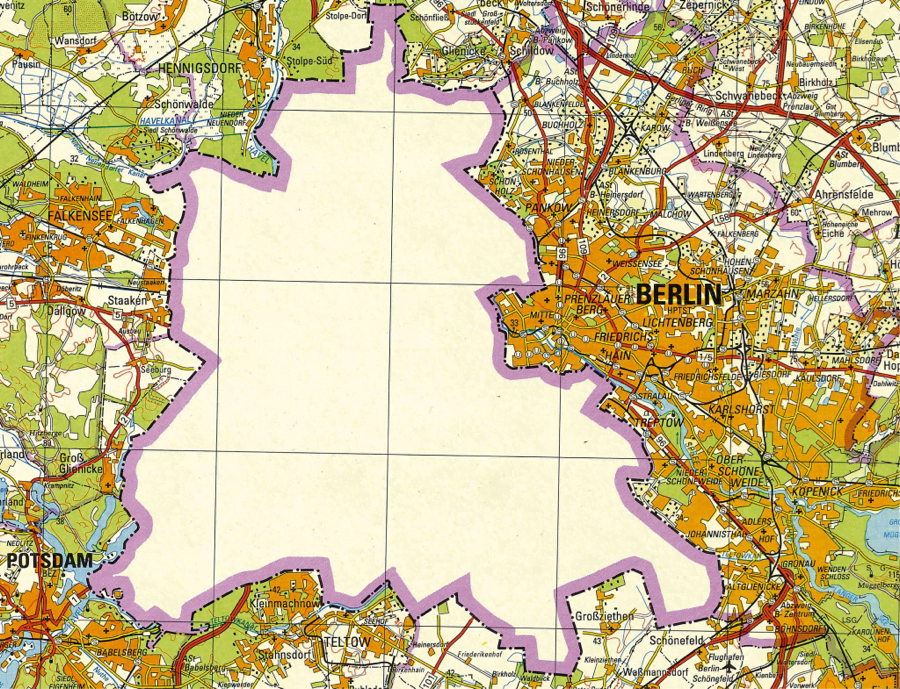 |
| 1980's map of Berlin |
The measures East & West Berlin were going through to hide and uncover information about themselves were new and intriguing to me, especially West Berlin being left off the map purposefully by East Berlin.
word count: 613

No comments:
Post a Comment