The Russian Revolution and the
formation of several parties along with financial woes created great challenges
for Germany and its people towards the end of World War I. The Bolshevists were
fueling many political protests within Germans’ minds using a lot of food
shortages. These revolutionary ideas are important at a time like this because majority
would never be attained in an election again by the current three parties
running for power: the Social Democrats, the Liberals, and the Center Party. Germany
doesn’t stay on firm ground because the “first German democracy emerged as the
product not of an elected parliament and strong political parties but rather of
a general staff at its wits’ end” (Hagen 197). This political indecision combined
with dramatic inflation created by France taking away Germany’s valuable mines
because Germans wouldn’t pay expensive war reparations caused great
instability.
 |
| The direction of payments for the Dawes Plan |
Germany thought it had it figured
out a solution though, with the Dawes Plan that allowed Germany to pay
reparations off to the U.S. based on loans that quickly spurred activity in
German production. This regaining of power was more of a false recovery
however, as export trades overshadowed the more important domestic trade that
was still struggling. Germany’s artificial economy was based on cartels,
misdistribution of loans, and high wage costs. This economy wasn’t furthering
German lives, but instead “had shaken the confidence of bourgeois society and
ended its role as a distinct class that dominated the cultural scene” (220).
The country was going back into social and economic turmoil and it didn’t help
that the current president had little political background.
A few more political parties
attempted to solve Germany’s problems and one that stood out was the National
Socialist German Worker’s Party (NSDAP). Adolf Hitler led this party and
attracted people by having rationally-based campaigns. Hitler was unique
because he “played to the emotional needs of the masses, which the established
parties ignored” (231). Mentioned earlier was the democracy formed from what a
staff of people thought was right, but Hitler decided to be more representative
of the people. When Hitler was chosen as chancellor in 1933, the Weimar
Republic was over. Hitler’s main plan of world dominance with a superior race over inferior people
was kept hidden very well initially behind other tactical moves. The army
Hitler worked with, the Reichswehr, was unconvinced and aggressive at first. However
this changed as Hitler made his new Reichwehr reduce his own branch of storm
troopers, the SA, and assassinating some leaders too. He affirmed his
dictatorship by controlling the minds of people he could and eliminating the
rest, “the Reichswehr remained silent even when its own generals Schleicher and
Bredow were killed” (250). While doing this, the minister of propaganda, Joseph
Goebbels, aided Hitler with controlling activities like book burnings,
attacking music, and an overall changing of any non-fitting culture. These
Hitler ideals stood outside of Germany as well. The “Germanization” of
conquered lands would be enforced by the Reichswehr now under his control.
 |
| Members of the National Socialist German Workers Party |
The people outside of Hitler’s main
circle weren’t aware of what Hitler’s overall goal was; Hitler wanted to go to
war from the beginning of his chancellorship to not only reverse World War I
results, but to gain more lebensraum and create world dominance. He
specifically planned that the economy of Germany would need to be ready within
four years for the war. This lebensraum was extended borders and more space for
the Germans to live, and it started when German forces marched into and took
Austria. This would end up being one of the few things that made the Germans
happy as they were reunited with their people from the past, “the German
population reacted with jubilation to the annexation of Austria, and so did the
majority of Austrians” (261). The annexing would continue as Britain and others
appeased Hitler with Czechoslovakia and then the Sudetenland where many more
German speaking people resided. Afterward, Britain couldn’t take anymore and
decided to make a pact with Russia, but it was too late as Hitler made a “pact”
with Russia that he was planning on going back on later. His next move was to
attack Britain, but after failed bombings with his Luftwaffe, he moved on and
chose to fight Russia now. When the British fought back by bombing, the Germans
were all stuck in bomb shelters and it “tended to wear down class
distinctions…listened to the same slogans from the radio, stood in line for
rationed goods…” (271). Unification amongst people was happening as the
separated were together again, differences turned into similarities, and not
much resistance was going on.
 |
| Austrians and Germans rejoiced when they were united again |
Unfortunately, this wasn’t exactly
the motive behind Hitler’s plans; it was merely the beginning of something much
worse. Poland was the next territory in Hitler’s sights. The second half of
Hitler’s goal was now being implemented to full effect. Millions of Jews would
be exterminated there and then in countless other locations as a way to achieve
German world domination. German public lost most of its fervor for Hitler,
trailing only a little longer with Goebbels and his propaganda. Germans spent
years back and forth determining what type of government should be in place.
Many views were shared amongst people and political parties, but by now they were feeling the shame of
what they had become a part of.
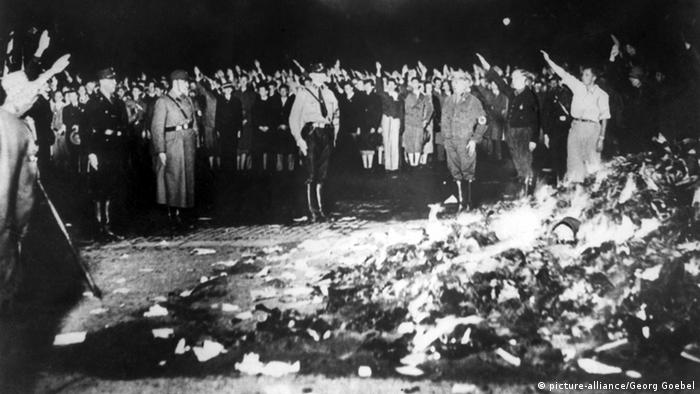 |
| Goebbels's book burning was one way of stopping unwanted culture |
Work Cited
Schulze, Hagen. "Germany: A New History". Trans. Deborah L. Schneider. Cambridge, MA: Harvard UP, 1998. Print
word count: 887

No comments:
Post a Comment